
License plates for drivers with qualifying disabilities can provide special identification and parking-related benefits under Maryland rules. Maryland disability plates are issued to eligible vehicle owners who meet the state’s disability requirements and submit the required documentation. These plates may be available for vehicles used by a person with a qualifying disability, with eligibility depending on the applicant’s circumstances. Knowing the basic requirements, application process, documentation, renewal rules, and permitted use can help vehicle owners prepare the correct information before applying.
License plates in Maryland can differ based on disability status, vehicle ownership, and the type of authorization requested. Disability plates may be connected with accessible parking privileges, but the plate itself does not replace every requirement for lawful parking. Applicants should review Maryland Motor Vehicle Administration requirements for eligibility, medical certification, vehicle registration, and renewal. Information about disability plate fees, placard options, replacement plates, and proper use can help drivers keep their registration current and follow state parking rules.
Who Qualifies for Disability License Plates?
A maryland handicap license plate is available to applicants who meet Maryland’s qualifying disability standards. The eligibility rules focus on mobility limits, the need for a wheelchair or assistive device, loss or loss of use of a limb, serious lung or cardiovascular conditions, and certain permanent visual impairments. Medical certification is required for most qualifying conditions, with a specific self-certification exception for disability code 6. The Maryland license plate MVA lists nine permanent disability categories for special parking placards or registration plates.
Qualifying Medical Conditions
Maryland lists these nine permanent disability categories:
- Severe lung disease: A person may qualify when lung disease results in very limited respiratory function, based on the medical measurements specified by Maryland.
- Severe cardiovascular disease: Eligibility can apply to cardiovascular disease classified as Class III or Class IV under American Heart Association standards.
- Limited walking ability: A person who cannot walk 200 feet without stopping to rest may meet the qualifying standard.
- Need for an assistive device: A person who cannot walk without a brace, cane, crutch, prosthetic device, another person, or another assistance device may qualify.
- Wheelchair use: A person who requires a wheelchair for mobility may qualify for disability parking plates or placards.
- Limb loss: A person who has lost an arm, hand, foot, or leg may qualify under disability code 6. This category has a special self-certification provision.
- Loss of use of a limb: A person who has lost the use of an arm, hand, foot, or leg may qualify even when the limb has not been physically lost.
- Severe permanent mobility disability: A permanent disability that seriously affects ambulatory ability may qualify when denial of the parking privilege would create significant hardship or a risk of injury.
- Severe visual impairment: A person may qualify with permanent impairment of both eyes meeting Maryland’s stated vision acuity or peripheral-field requirements.
Who Can Certify a Disability?
Maryland permits several licensed healthcare professionals to provide medical certification, depending on the disability code. A licensed physician, physician assistant, or nurse practitioner may certify all qualifying conditions listed on the VR-210. A licensed chiropractor, podiatrist, or physical therapist may certify disability codes 3 through 8 and temporary code 10. A licensed optometrist may certify qualifying vision conditions under code 9.
Self-Certification for Limb Loss
Disability code 6 has a specific exception. A person who has lost an arm, hand, foot, or leg may self-certify this qualifying condition by appearing in person at a full-service MVA office with proper identification. In that situation, the applicant’s name and disability code 6 are recorded on the application. When a doctor certifies the limb loss instead, the doctor must complete the applicable medical certification section.
How to Apply for a Maryland Handicap License Plate
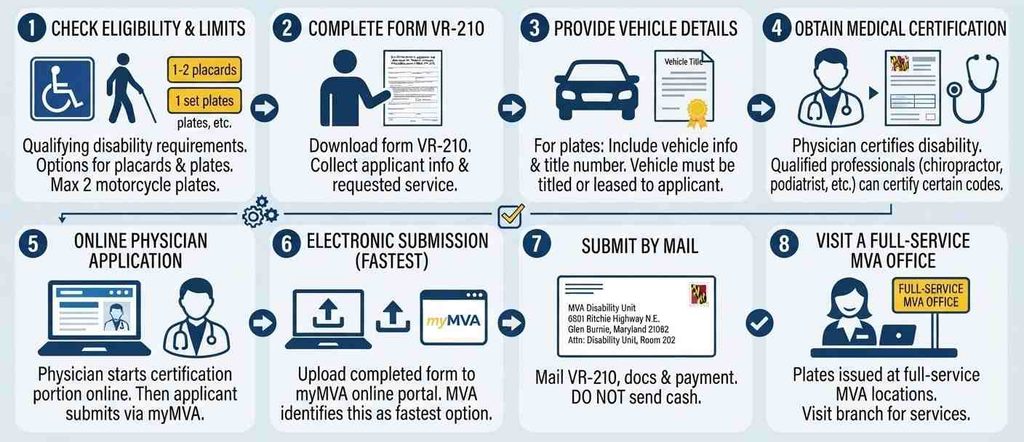
A maryland handicap license plate application starts with Maryland Motor Vehicle Administration (MVA) Form VR-210, titled the Application for Maryland Parking Placards/License Plates. The form is used for new disability plates, replacement requests, and qualifying parking placards. The MVA currently offers online submission, electronic upload, and mail options, with online processing promoted as the fastest option.
- Apply for a Maryland Handicap License Plate – Official MVA Page:
- https://mva.maryland.gov/your-mva-guide/individuals-disabilities/disability-plates-placards
Disability Plates vs. Disability Placards
Maryland offers both a disability plate and a placard for qualifying people who need disabled parking privileges. The main difference is how each one is connected to a vehicle. Disability license plates are issued for a specific eligible vehicle, while placards are portable and can move from one vehicle to another. Maryland MVA allows eligible people with permanent disabilities to request one or two placards, one set of disability plates, or one placard together with one set of disability plates.
| Feature | Disability License Plate | Disability Placard |
|---|---|---|
| Use | Connected to a specific vehicle | Portable and can be used in different vehicles |
| Best for | A person who regularly uses the same personal vehicle | A person who frequently rides in different vehicles |
| Vehicle-Specific | Yes | No |
| Portability | Cannot be moved between vehicles as a portable permit | Can be moved from one vehicle to another when the eligible person is traveling in that vehicle |
| Type | Disability registration plate | Permanent or temporary parking placard |
| Permanent Disability | Available for qualifying permanent disabilities | Blue permanent placard available for qualifying permanent disabilities |
| Temporary Condition | A temporary condition is generally handled through a placard rather than a disability plate | Red temporary placard is available for qualifying temporary mobility conditions |
| Parking Privileges | Provides applicable disabled parking privileges when displayed on the registered vehicle | Provides applicable disabled parking privileges when properly displayed |
| Convenience | Convenient for a primary personal vehicle | More convenient for multiple vehicles |
| Combination Options | Eligible applicants may request one set of disability plates | Permanent disability applicants may request one or two placards, including a placard with one set of disability plates |
| Issuing Agency | Maryland Motor Vehicle Administration (MVA) | Maryland Motor Vehicle Administration (MVA) |
Disability License Plate Fees
The cost of a maryland handicap license plate is separate from the cost of regular vehicle registration. Maryland MVA Form VR-210 provides the fee information for disability plates and placards. The current form states that there is no fee for disability placards, including permanent and temporary placards. A disability plate or motorcycle disability plate requires the applicable substitute/replacement tag fee.
| Fee Type | Current Amount | Details |
|---|---|---|
| Disability Placard | No fee | Maryland MVA does not charge a fee for disability placards. |
| Disability License Plate | $20 | The current VR-210 states that a disability plate request requires a substitute/replacement tag fee. |
| Motorcycle Disability Plate | $20 | The VR-210 applies the same substitute/replacement tag fee to a motorcycle disability plate request. |
| Vehicle Registration | Additional fee | If registration is due at the same time as the disability plate request, the applicable vehicle registration fee is charged separately. |
| Registration Surcharge | $40 annually, where applicable | Maryland’s general registration fee schedule includes a annual EMS surcharge for applicable vehicle registrations. |
Disability Plate Parking Privileges
A valid disability plate or disability placard can provide qualifying drivers with special parking privileges in Maryland. These benefits may apply to designated disabled parking spaces, certain parking meters, and some time-limited parking areas. The privileges have specific limits, so drivers still need to follow posted signs and restrictions at the parking location.
Designated Accessible Parking Spaces
- A valid disability plate or placard may allow the vehicle to park in a designated accessible parking space.
- Accessible spaces may include standard wheelchair spaces and van-accessible spaces with an additional access aisle.
- Drivers should use spaces according to the signs and pavement markings at the location.
- A disability credential does not give permission to use spaces reserved for another specific purpose.
Parking Meter Privileges
- Maryland provides certain parking meter privileges for qualifying disability parking users.
- Applicable meter rules can provide fee exemptions or additional parking time in qualifying situations.
- Drivers should check the meter, posted signs, and local parking requirements before leaving the vehicle.
Time Limits
- A disability credential may provide extended parking time in certain locations with a posted time limit.
- The specific benefit can depend on the type of parking area and applicable Maryland or local rules.
- Posted restrictions should always be followed when they set a maximum parking period or restrict parking during certain hours.
When Privileges Do Not Apply
- A disability plate does not permit parking where stopping, standing, or parking is prohibited for all vehicles.
- It does not override fire lanes, no-parking areas, traffic restrictions, or other posted prohibitions.
- Drivers must follow restrictions that reserve a space for a particular vehicle type or purpose.
- Local parking signs can impose requirements that remain applicable to disability parking users.
Van-Accessible Spaces
- Van-accessible spaces are marked accessible spaces with additional clearance for wheelchair ramps and lifts.
- A vehicle displaying a valid disability plate or placard may use an accessible space when permitted by the posted markings.
- The access aisle beside a van-accessible space should remain clear so wheelchair equipment can be deployed safely.
Replacing a Lost, Stolen, or Damaged Disability Plate
A lost, stolen, or damaged disability plate should be replaced through the Maryland Motor Vehicle Administration (MVA). The replacement process requires the appropriate application, and stolen plates requirements police report information. Applicants can use Form VR-210 and submit the required details to MVA for a substitute plate. The process may vary based on whether the plate was lost, stolen, or damaged, so applicants should provide accurate information and any required documentation when requesting a replacement Maryland handicap license plate.
Report a Stolen Disability Plate
If your disability plate has been stolen, report the theft to your local law enforcement agency. The Maryland MVA requires the police report number and the jurisdiction where the theft was reported for the replacement application. This information should be entered on the VR-210 application.
Complete Form VR-210
For a lost, stolen, or damaged disability plate, complete the Application for Maryland Parking Placards/License Plates (VR-210). Provide the required replacement information, including relevant plate details and police report information when applicable.
Provide Police Report Information
For a stolen disability plate, include the police report number and the reporting jurisdiction on the application. For a lost plate, provide the required information about the loss. Providing accurate details helps the MVA process the replacement request.
Submit the Replacement Application
Submit the completed VR-210 to the Maryland MVA using an accepted submission method. Applicants may visit a full-service MVA office for applicable services or use another submission option provided by the MVA. The Maryland MVA handles disability plate replacement.
Pay the Applicable Fee
A replacement or substitute plate may require an applicable MVA fee. The current VR-210 lists the fee that applies to disability plate requests. Regular vehicle registration charges, when applicable, are separate from the plate replacement charge.
Receive the Replacement Plate
After the application is processed, the replacement disability plate is issued by the Maryland MVA. This website provides informational content only and does not issue, replace, or process applications for a maryland handicap license plate.
Renewing Disability Plates
A disability plate is connected to the vehicle’s disability registration, so it is maintained through the vehicle registration process rather than renewed like a permanent disability placard. Maryland MVA states that disability plates must display current registration stickers, which means the vehicle registration needs to remain current.
Keep Registration Current
- Complete registration renewal before the current registration expires.
- Check the registration expiration date on the vehicle’s current registration documents.
- Keep the vehicle’s registration active to continue using the disability plate legally.
- Maryland registration periods can vary based on the vehicle and registration circumstances.
Current Registration Sticker
- A disability plate must display a current registration sticker as required by Maryland MVA.
- The registration sticker shows that the vehicle’s registration is current.
- After renewal, use the new registration sticker according to MVA instructions.
- A disability plate should not be treated like a permanent disability placard that has its own separate renewal process.
How to Renew
- Eligible vehicle owners can use Maryland MVA’s available online registration renewal service.
- Mail and in-person renewal options may be available based on the vehicle and registration situation.
- The applicable registration fee is separate from any disability plate-related fee.
- Check current MVA requirements before submitting a renewal request, since fees and eligibility can vary by vehicle.
DV Plates and Disabled Veteran License Plates
Maryland DV plates are a separate category of veteran license plates for qualifying veterans with a service-connected disability rating. The Maryland MVA currently recognizes different disabled veteran plate options based on the veteran’s disability rating. The key difference is that a 100% Disabled Veteran plate can be issued with or without the wheelchair symbol, while the 50–99% Disabled Veteran plate does not display the wheelchair symbol. These plates should not be treated as identical to regular disability plates.
| Feature | 100% Disabled Veteran Plate | 50–99% Disabled Veteran Plate | Regular Disability Plate |
|---|---|---|---|
| Eligibility | Veterans with a qualifying 100% service-connected disability rating or applicable 100% unemployability status | Veterans with a qualifying 50–99% service-connected disability rating or applicable unemployability status | Applicants who meet Maryland’s qualifying disability requirements |
| Veteran Status | Required | Required | Not required |
| Service-Connected Disability | Yes | Yes | Not specifically required |
| Wheelchair Symbol | Certain 100% DV plate formats can display the wheelchair symbol | No wheelchair symbol | Yes, disability plates display the wheelchair symbol |
| Plate Name | Disabled Veteran | Disabled Veteran | Disability plate |
| Registration Costs | Eligible 100% disabled veterans may qualify for free plate and permanent registration under MVA requirements | Plate is free, but applicable registration fees and surcharge may apply | Applicable vehicle registration and disability plate fees apply |
| Main Purpose | Recognizes qualifying 100% disabled veteran status and may provide disability-related parking benefits when the wheelchair format is issued | Recognizes qualifying disabled veteran status | Provides disability-related plate and parking privileges |
| MVA Category | Military/Veteran plate | Military/Veteran plate | Disability plate |
Using Maryland Disability Plates in Other States
A Maryland disability plate or valid disability placard can be used for accessible parking when traveling outside Maryland. Maryland MVA states that all states must recognize removable disability placards, temporary disability placards, and special disability license plates issued by another state for use in spaces reserved for people with disabilities. This recognition supports out-of-state parking and allows qualifying drivers to use designated accessible parking spaces according to the laws of the state they are visiting.
Accessible Parking in Other States
- A valid Maryland disability plate can be recognized for parking in designated accessible parking spaces in other states.
- A removable Maryland disability placard can provide the same type of parking recognition when properly displayed.
- The person with the disability should be present when using disability parking privileges.
- Local signs and parking restrictions still apply at the destination.
Parking Meter Rules Can Differ
- Maryland’s own parking meter accommodations do not automatically apply outside the state.
- Another state or city may require a person with a disability to pay parking meter fees.
- The amount of free parking time or extended parking privileges can vary by jurisdiction.
- Check local parking meter rules before relying on a fee exemption or extended time.
Check Local Restrictions
A Maryland disability credential gives recognition for designated accessible parking, but it does not remove every local restriction. Drivers should check posted signs, meter instructions, time limits, and other parking requirements before leaving the vehicle. This is especially important for out-of-state parking, since each jurisdiction can apply its own rules for fees and parking duration.
Frequently Asked Questions
Maryland handicap license plates, including who qualifies, which application is required, how to apply, and what Form VR-210 is used for. These answers give readers quick access to the key eligibility and application details without needing to review the full process.
What is a Maryland handicap license plate?
A Maryland handicap license plate is a disability plate issued by the Maryland Motor Vehicle Administration (MVA) for a person who meets Maryland’s qualifying disability requirements. The plate displays the universal wheelchair symbol and is connected to an eligible vehicle. It provides applicable parking privileges for spaces reserved for people with disabilities.
Who qualifies for a Maryland disability license plate?
Eligibility is based on specific medical conditions listed by the Maryland MVA. These include severe lung or cardiovascular disease, inability to walk 200 feet without resting, use of mobility aids, wheelchair use, limb loss or loss of limb function, severe permanent mobility limitations, and qualifying visual impairment. Most conditions require medical certification from an authorized healthcare professional.
How do I get a Maryland handicap license plate?
To get a Maryland handicap license plate, complete Form VR-210 and obtain the required medical certification. For a plate request, the applicant completes Sections A and B, while an approved medical provider completes Section C when required. The application can then be submitted online, electronically through myMVA, or by mail. Disability plates are issued at full-service MVA offices.
What form is used for Maryland disability plates?
Maryland uses Form VR-210, Application for Maryland Parking Placards/License Plates, for disability plate and placard requests. For a disability plate, the applicant completes Sections A and B, and an approved medical provider completes Section C when medical certification is required. The form can be submitted through the MVA’s accepted online, electronic, or mail options.
What is Form VR-210?
VR-210 is the Maryland MVA application used to request disability parking placards, disability license plates, and motorcycle disability plates. It contains the applicant, vehicle, and medical certification sections. The form states that placards have no fee, while a disability plate or motorcycle plate request requires the applicable substitute or replacement tag fee.