
License plates for commercial vehicles in Maryland identify vehicles used for business, transportation, delivery, construction, and other commercial activities. These plates can be connected with vehicle registration requirements that vary based on the vehicle type, weight, use, and business purpose. Owners and operators may need to meet specific Maryland registration rules before placing a commercial vehicle on public roads. Knowing the applicable plate class, registration requirements, fees, and documentation can help vehicle owners keep their commercial vehicles properly registered and compliant with state requirements.
License plates for commercial vehicles can differ from standard passenger plates in their registration classification and eligibility requirements. Maryland commercial vehicle owners may need to provide vehicle information, ownership documents, insurance details, and other records based on the registration category. Commercial trucks, trailers, vans, and other qualifying vehicles can have different requirements depending on their intended use. Reviewing the correct Maryland commercial registration category can help owners identify applicable fees, renewal requirements, weight classifications, and plate rules before completing a registration transaction.
How to Get Commercial Plates in Maryland
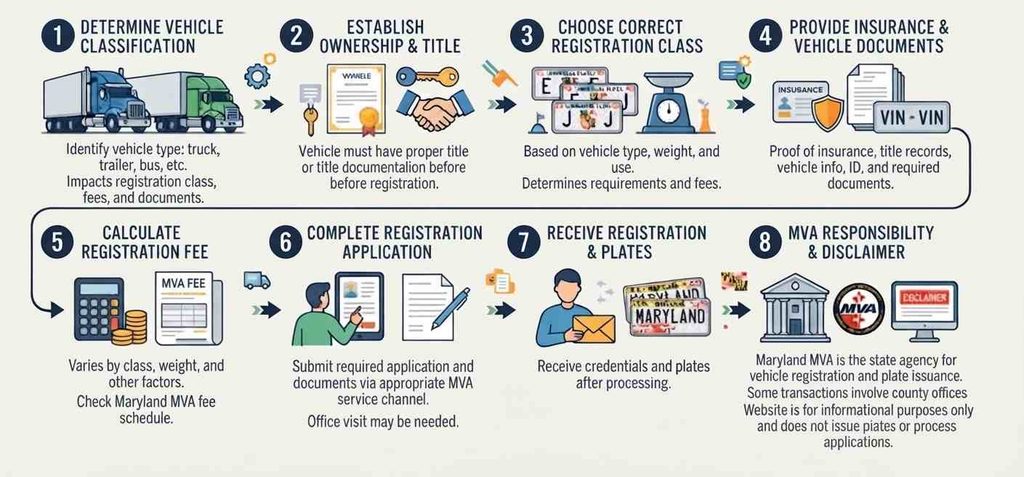
Getting commercial plates in Maryland starts with identifying how the vehicle is classified and how it will be used. Maryland MVA states that commercial vehicle titling and registration requirements can vary by vehicle type, weight, and use, so the process is not identical for every commercial vehicle. Common categories include trucks, buses, corporate vehicles, dump trucks, farm vehicles, and other specialized commercial vehicles.
- Commercial Vehicle Titles & Registration:
- https://mva.maryland.gov/your-mva-guide/businesses/commercial-vehicle-titles-registration
Documents and Requirements for Commercial Plates
The documents required for commercial registration in Maryland depend on the vehicle, its use, registration class, and the type of plate requested. Maryland MVA requirements can differ for standard commercial vehicles, dealer operations, and vehicles using apportioned registration under the International Registration Plan (IRP). Checking the correct category before submitting paperwork can help prevent delays.
Standard Commercial Registration
A typical commercial vehicle registration may require the following:
- Title or other proof of ownership for the vehicle.
- Completed title and registration paperwork.
- Current insurance information that meets Maryland requirements.
- Vehicle information such as VIN, weight, mileage, and other applicable details.
- Business information when the vehicle is titled or registered to a company.
- Federal Employer Identification Number (FEIN) for certain business title transactions.
- Applicable registration taxes and fees.
- Any inspection or supporting documents required for the specific vehicle class.
Dealer Plates
A dealer registration follows a different process because dealer plates are connected with an MVA-issued dealer license. Licensed dealers may receive interchangeable dealer tags for eligible business activities. Dealer applicants must meet MVA business licensing requirements before receiving these plates.
- Valid MVA dealer license.
- Required dealer business documentation.
- Proof of required liability insurance.
- Applicable dealer plate fees.
- Required MVA forms and business records.
IRP / Apportioned Registration
Apportioned registration applies to qualifying commercial vehicles operating in Maryland and other IRP jurisdictions. The IRP system bases registration on interstate operations and mileage. Maryland mva locations permits qualifying applicants to submit IRP registration through the myMVA Business Portal.
- USDOT information, where applicable.
- FEIN or business identification information.
- Vehicle and weight information.
- Jurisdiction and mileage records.
- Supporting ownership and insurance documents.
- Applicable IRP fees and registration details.
- Final registration credentials issued through the MVA process.
Commercial Vehicle Registration Classes
License plates for commercial vehicles in Maryland are organized into registration classes based on vehicle type, weight, and use. The Maryland MVA uses categories such as Class E for trucks, Class F for truck tractors, and Class G for trailers and semi-trailers, with GVW and GCW helping determine the applicable registration requirements and fees. Knowing the correct registration class can help vehicle owners identify the appropriate commercial registration category and the plate requirements for their vehicle.
Class E — Trucks
Class E is used for qualifying trucks registered for commercial use in Maryland. The applicable registration category is tied to the truck’s gross vehicle weight (GVW), with different weight ranges affecting the registration fee. For businesses using trucks to transport goods, equipment, or other loads, the vehicle’s weight rating is an important part of the registration process. The Maryland MVA fee schedule lists Class E fees by weight category, so the correct registration class depends on the truck and its permitted weight.
Class F — Truck Tractors
Class F applies to qualifying truck tractors, including vehicles used with trailers or semi-trailers. Registration fees for these vehicles can be based on the gross combination weight (GCW) of the tractor and attached equipment. This class is common for commercial operations involving larger freight combinations. Maryland also provides separate farm-related classifications within its commercial registration system, so a farm truck tractor may follow a different fee category from a standard commercial tractor.
Class G — Trailers and Semi-Trailers
Class G covers certain trailers, semi-trailers, and house trailers. The applicable fee can depend on the trailer’s maximum gross weight. Maryland’s fee schedule separates freight trailers and semi-trailers from certain non-freight trailers, making the trailer’s purpose relevant to the registration category. A business should identify whether its trailer is used for freight transportation or another purpose before selecting the applicable registration class.
Farm Commercial Vehicle Classes
Maryland provides separate registration classifications for qualifying farm vehicles, including farm trucks and farm truck tractors. These classifications recognize agricultural use and can have different registration fees from standard commercial vehicles. Farm trailers and semi-trailers can have their own applicable categories based on vehicle type and weight. Owners should check the MVA requirements for the specific farm vehicle rather than assuming a standard commercial class applies.
How Weight Affects Commercial Plate Fees
The connection between a commercial vehicle, registration class, and plate fee is largely based on vehicle type and weight. Class E trucks use GVW categories, while Class F truck tractors can use GCW categories. Class G trailers use applicable gross weight ranges and may distinguish freight from non-freight equipment. As a result, the correct registration fee is determined after the vehicle’s class and applicable weight category are established. The Maryland MVA fee schedule should be checked for the current amount before registration.
Commercial Plate Fees in Maryland
The cost of commercial plates in Maryland varies by registration class, vehicle weight, and type of registration. Maryland MVA does not use one fixed price for every commercial vehicle. Class E trucks and Class F truck tractors use weight-based fee structures, while trailer fees depend on the trailer category and weight. Dealer plates have separate annual fees, and IRP or apportioned registration has its own charges. The MVA fee schedule is the best source for current amounts.
| Plate / Registration Type | Maryland Class | Fee Basis | Current Fee |
|---|---|---|---|
| Commercial Trucks | Class E | GVW/weight category | Varies by weight |
| Truck Tractors | Class F | GCW/weight category | Varies by weight |
| Trailers | Class G | Gross weight | Varies by weight |
| Freight Trailers / Semi-Trailers | Class G / applicable category | Trailer type and weight | $68.25 |
| Dealer Plates | Class 1A | Annual fee | $50 |
| Motorcycle Dealer Plates | Class 1B | Annual fee | $25 |
| Trailer Dealer Plates | Class 1C | Annual fee | $32.50 |
| IRP / Apportioned Registration | IRP | Jurisdictions, weight, and operation | Varies |
| EMS Surcharge | Applicable commercial classes | Annual surcharge | $40 |
Maryland Trailer License Plates
License plates for trailers in Maryland are based on the trailer type, registration class, and gross weight. The Maryland MVA uses Class G for certain trailers, semi-trailers, and house trailers, while freight trailers can follow a separate fee category. The applicable trailer plate and annual registration fee can vary based on how the trailer is used and its weight, so owners need to identify the correct category before completing trailer registration.
Maryland Trailer Registration
A Maryland trailer license plate is issued through the trailer registration process, with the applicable registration class based on the trailer type and weight. Maryland MVA separates non-freight trailers, freight trailers, and semi-trailers into different fee categories. The registration requirements can vary according to how the trailer is used, its maximum gross weight, and whether it operates with a Class E truck or Class F tractor.
Class G Trailers and Semi-Trailers
Class G covers trailers, semi-trailers, and house trailers classified as non-freight vehicles. The current MVA fee schedule lists weight-based registration fees for trailers up to 20,000 pounds. The listed annual fees are $55.50 for 3,000 pounds or less, $81 for 3,001–5,000 pounds, $110 for 5,001–10,000 pounds, and $154 for 10,001–20,000 pounds.
Freight Trailers and Semi-Trailers
A freight trailer or freight semi-trailer follows a separate registration category from ordinary Class G non-freight trailers. Maryland MVA describes freight trailers and semi-trailers as equipment designed to be towed by a Class E truck or Class F tractor, with the applicable registration treatment based on the trailer’s use and weight. The current MVA fee schedule lists a separate $68.25 fee for a freight trailer or semi-trailer.
Non-Freight Trailers
Non-freight trailers are registered according to their maximum gross weight under the applicable trailer category. This can include certain utility-type trailers and house trailers that do not fall into the freight category. Maryland MVA uses specific weight brackets for these registrations, so the trailer’s gross weight can directly affect the annual registration fee.
Cost of Maryland Trailer License Plates
The cost of Maryland trailer license plates depends on the trailer’s registration category and weight rather than one flat amount. For standard Class G trailers, the current MVA schedule ranges from $55.50 to $154 for trailers up to 20,000 pounds. Freight trailers and semi-trailers have a separate listed fee. These amounts can change, so the current Maryland MVA fee schedule should be checked before registration.
Trailer Dealer Plates vs. Regular Trailer Registration
A trailer dealer plate is different from regular trailer registration. Dealer plates are interchangeable plates issued under Maryland’s dealer licensing system, while a regular trailer plate is connected with registering the trailer for its intended use. The MVA currently lists a Class 1C trailer dealer plate at $32.50 annually. A trailer owner should use the registration category that matches the vehicle and its purpose.
Motorcycle Plates for Commercial and Dealer Use
Maryland motorcycle plates can fall into two different categories: regular motorcycle registration and motorcycle dealer plates. These categories have different registration classes and purposes, so separating them makes the information easier to follow.
Regular Motorcycle Registration
Class D is used for regular motorcycle and autocycle registration. The plate is issued as part of the registration for the individual motorcycle.
- Class D: Motorcycle and autocycle registration
- Used for regular motorcycle registration
- The motorcycle plate is associated with the registered vehicle
- Applicable registration requirements and fees depend on the vehicle and MVA rules
Motorcycle Dealer Plates
Class 1B applies to licensed motorcycle dealers seeking an interchangeable dealer plate. These plates support authorized dealer business activities and are different from plates issued for ordinary motorcycle ownership.
- Class 1B: Motorcycle dealer plate
- Used by licensed motorcycle dealers
- Interchangeable plate category
- Subject to dealer registration and MVA requirements
Class D vs. Class 1B
| Feature | Class D | Class 1B |
|---|---|---|
| Registration Type | Regular motorcycle registration | Motorcycle dealer registration |
| Plate Type | Motorcycle plate | Interchangeable dealer plate |
| Main Use | Registered motorcycle | Authorized dealer business activities |
| Registration Class | Class D | Class 1B |
IRP Fees, Mileage, and Cab Cards
IRP (International Registration Plan) applies to qualifying commercial vehicles that operate in Maryland and other member jurisdictions. IRP fees are not based on one flat commercial plate amount; they can be affected by reported mileage, jurisdictional mileage percentages, vehicle weight, and the registration details. An apportioned plate and cab card provide the registration credentials for interstate operations, while mileage and operational records support the information reported for the registration.
IRP and Apportioned Registration
IRP (International Registration Plan) is a form of apportioned registration for qualifying commercial vehicles that operate in Maryland and other member jurisdictions. Unlike a simple flat commercial plate fee, IRP charges are connected with the vehicle’s interstate operation, reported mileage, jurisdictions traveled, and applicable weight. Maryland MVA states that qualifying vehicles can register through its Business Portal.
Mileage Percentage and IRP Fees
IRP uses mileage percentage to apportion registration fees among member jurisdictions. A carrier’s reported distance in each jurisdiction is used as part of the calculation, rather than applying one identical fee to every interstate vehicle. The vehicle’s gross weight, reported operations, and jurisdictional mileage can affect the amount of registration fees assigned through the IRP system.
Operational Records and IVMR
Carriers using apportioned registration must maintain operational records supporting the mileage reported on their IRP registration application. Maryland MVA identifies records such as trip sheets, fuel reports, logs, and Individual Vehicle Mileage Records (IVMR) as acceptable mileage documentation. Records can include trip dates, origin and destination, route, odometer readings, total miles, and miles traveled in each jurisdiction.
Cab Card and Apportioned Plate
After an IRP registration is processed, the carrier receives an apportioned plate and a cab card showing the jurisdictions and weight information associated with the registration. The current Maryland MVA fee schedule lists a $5 fee for a new cab card, $5 for a duplicate or replacement cab card, $2 for temporary authorization, and $15 for a trip permit. These are separate from the overall apportioned registration fees.
Commercial Plate Renewal and Compliance
Commercial vehicle registration in Maryland must remain current throughout the registration period. Commercial registration, dealer plates, and apportioned registration can have different renewal requirements, records, and credentials. Keeping insurance information, mileage records, plate inventory, and registration documents current helps businesses maintain valid vehicle records and meet applicable Maryland MVA requirements.
Registration Renewal
A commercial vehicle registration must be renewed before its registration expiration date to keep the vehicle legally registered. The renewal process can vary by registration class, vehicle type, and the services available through Maryland MVA. Owners should keep current insurance, registration information, and required registration credentials connected with the vehicle.
Dealer Plate Renewal
Licensed dealers must maintain their dealer plates and dealer license according to Maryland MVA requirements. Interchangeable dealer tags are subject to renewal and ongoing plate inventory controls. Dealers using the MVA Business Portal may handle certain plate-related transactions and should keep their dealer records current.
IRP Renewal and Cab Cards
For vehicles using apportioned registration, IRP renewal requires current vehicle, jurisdiction, weight, and mileage information. Carriers should maintain mileage records and supporting operational records for reported activity. The cab card should reflect the current IRP registration details, including authorized jurisdictions and weight information.
Compliance and Reporting Changes
Commercial and dealer registrants should report applicable changes to vehicle, business, insurance, or registration information through the proper Maryland MVA process. Lost, damaged, or changed registration credentials may require replacement documentation. When a plate or credential must be surrendered or plate return the MVA’s applicable instructions should be followed. Keeping registration, insurance, mileage, and plate records current helps maintain compliance.
Commercial Plates vs Dealer Plates vs Apportioned Plates
Commercial, dealer, apportioned, trailer, and motorcycle plates serve different registration purposes in Maryland. The main difference is the vehicle type, business purpose, and type of operation connected with the registration. Knowing these distinctions helps users identify which registration category may apply to a particular vehicle.
| Feature | Commercial Plates | Dealer Plates | Apportioned Plates |
|---|---|---|---|
| Main Purpose | Registration of qualifying commercial vehicles | Authorized use by licensed vehicle dealers | Interstate commercial operation under IRP |
| Typical Users | Businesses and commercial vehicle owners | New, used, wholesale, motorcycle, and trailer dealers | Carriers operating in multiple member jurisdictions |
| Registration Basis | Vehicle type, class, and weight | Dealer license and plate class | Mileage, jurisdictions, weight, and IRP requirements |
| Classes | Class E, Class F, Class G | Class 1A, 1B, 1C | IRP registration |
| Plate Type | Commercial vehicle plate | Interchangeable dealer plate | Apportioned plate |
| Examples | Truck, tractor, trailer | Vehicle dealer, motorcycle dealer, trailer dealer | Interstate commercial truck |
| Key Document | Registration credentials | Dealer license and dealer records | Cab card |
| Fee Basis | GVW/GCW and registration class | Separate dealer plate fee | Apportioned registration calculation |
Frequently Asked Questions
Maryland commercial plates often involve registration classes, dealer plates, apportioned registration, fees, and eligibility. This section answers key questions about commercial vehicle registration, IRP plates, dealer plates, and related requirements in clear terms, helping readers identify the registration category that may apply to their vehicle or business.
What are commercial plates in Maryland?
Commercial plates in Maryland are registration plates issued for qualifying vehicles used for commercial purposes. The applicable registration class can depend on the vehicle type, weight, and use. Maryland uses classifications such as Class E for trucks, Class F for truck tractors, and Class G for certain trailers and semi-trailers, with fees based on the relevant category.
How do I get commercial plates in Maryland?
To obtain commercial plates, the vehicle owner generally needs to complete the applicable commercial registration process with the Maryland MVA. Requirements can include the vehicle title, proof of ownership, insurance information, vehicle details, applicable registration class, and fees. The exact paperwork can vary based on the vehicle type, weight, business use, and registration category.
How do I get apportioned plates in Maryland?
Qualifying interstate commercial vehicles can apply for apportioned registration (IRP) through Maryland’s International Registration Plan process. The application can require business and vehicle information, reported mileage, jurisdictions, and applicable weight details. After processing, the carrier receives the appropriate apportioned plate and cab card showing the jurisdictions and weight information covered by the registration.
Who needs an apportioned plate in Maryland?
An apportioned plate is generally used by qualifying commercial vehicles that operate in Maryland and other IRP member jurisdictions. The IRP system apportions registration based on factors such as jurisdictional mileage, vehicle weight, and interstate operation. Carriers need to maintain supporting operational and mileage records for the information reported as part of their apportioned registration.
What are Maryland dealer plates?
Maryland dealer plates are interchangeable plates issued to licensed dealers for authorized dealership activities. Dealer plate categories include Class 1A for certain new, used, and wholesale vehicle dealers, Class 1B for motorcycle dealers, and Class 1C for trailer dealers. Dealer plates are different from ordinary commercial plates because they are connected to the dealer’s licensed business operations rather than standard registration of a commercial vehicle.