License plates in Maryland reflect a long history of changing designs, state identity, and vehicle registration practices. From early plates with simple numbering to modern designs featuring the Maryland flag, each style has helped represent the state on roads across the country. Maryland plate designs have changed in color, format, materials, and visual elements over time. This page covers major Maryland license plate designs, notable changes, historical plate styles, and the development of the current Maryland license plate used today.
License plates provide more than vehicle identification in Maryland; they preserve details about the state’s transportation history and changing design preferences. Maryland license plate history includes early numbered plates, classic state-issued styles, and modern options created for different vehicle owners. The current Maryland license plate reflects strong state imagery, with the Maryland flag playing a central role in its appearance. Reviewing older and newer MD license plate designs makes it easier to see how Maryland plates have changed across different periods.
Current Maryland License Plate Design
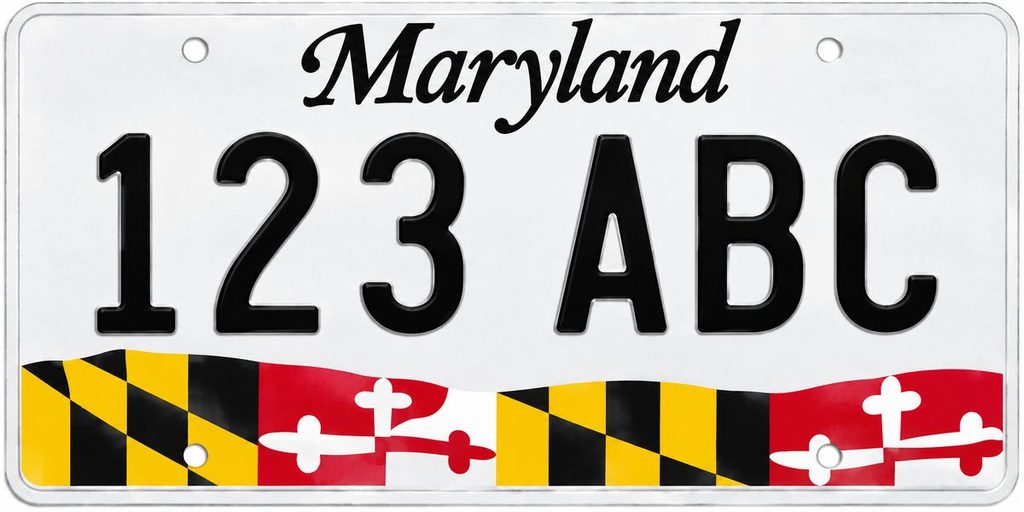
The Maryland Proud design is one of the defining maryland plate designs used for the state’s standard passenger plates. Introduced on September 26, 2016, it replaced the War of 1812 design for new standard plate issues. The new Maryland license plate design features the state’s distinctive flag, giving the current Maryland license plate a strong connection to Maryland’s identity. The Maryland flag uses black, gold, red, and white elements arranged in its traditional pattern. The words “Maryland” and the registration characters appear as part of the overall plate layout. For people comparing MD license plate designs, the Maryland Proud plate is easy to recognize by its flag graphic and clean registration layout. Existing older plates can still look different, since plates issued before the 2016 change may feature earlier designs.
Maryland Plate Colors, Graphics and Layout
The current plate appearance combines a light plate background with dark registration characters and the Maryland flag graphic. The white background provides a clear surface for the serial, while the black characters make the letters and numbers easy to distinguish. “Maryland” appears in red, adding another state-specific element to the color scheme. The Maryland flag graphic occupies a prominent part of the plate and gives the current design its most recognizable visual feature. This graphic arrangement creates a clear difference from older Maryland plates that used previous artwork, colors, or layouts. When comparing Maryland plates from different periods, the flag placement, background, serial area, and state name are useful markers for identifying the plate design and approximate issue period.
Maryland License Plate Designs by Year
Maryland license plates can be identified by their design period, serial progression, and registration information. The major modern change came in 2016, when the Maryland Motor Vehicle Administration introduced the Maryland Proud plate as the new standard issue. The same flag-based design continued in later years, with serial numbers progressing through different ranges. A year linked to a Maryland plate does not always mean a new graphic design was released. In many cases, the year refers to a registration period, sticker, or serial range. This distinction helps separate actual Maryland license plate designs by year from routine registration changes.
Plate 2016
The Maryland license plate 2016 marked the transition from the War of 1812 standard plate to the Maryland Proud design. MVA began issuing the new standard plate on September 26, 2016. The alphanumeric scheme was retained, but the new plate removed the stacked letters used on the previous standard format. This produced a cleaner serial presentation and gave the Maryland flag a prominent position in the plate layout.
Key 2016 changes included:
- September 26, 2016: Maryland Proud standard plates began issuance.
- Previous design: War of 1812 standard plate.
- Serial format: Existing alphanumeric scheme continued.
- Letter layout: Stacked letters were removed.
- Visual change: Maryland flag became a major feature of the standard plate.
- Older plates did not have to be replaced solely because of the new design.
Plates 2020
Maryland license plates 2020 continued the Maryland Proud standard graphic introduced in 2016. There was no separate standard plate redesign for 2020. The year is more useful for identifying registration periods and serial progression than for identifying a new plate appearance. The physical plate continued to show the familiar Maryland flag-based layout.
Key 2020 details included:
- Standard design: Maryland Proud.
- Graphic: Maryland flag remained part of the plate.
- Design change: No separate standard redesign.
- Serial progression: Records show progression through the DE and DP ranges.
- Registration context: Black-on-white registration stickers were associated with the period.
- The 2020 reference should not be treated as a separate standard graphic design.
Plate 2023
The Maryland license plate 2023 continued the Maryland Proud appearance. The Maryland flag remained the defining graphic on the standard plate, with no separate standard design introduced specifically for 2023. Serial numbers continued their natural progression during the registration periods associated with the year.
Key 2023 details included:
- Standard design: Maryland Proud.
- Maryland flag: Continued as the main graphic feature.
- New standard graphic: None introduced for 2023.
- Serial progression: Approximately from the EM series through the EX series in listed registration records.
- Year reference: Primarily relates to registration and serial progression.
- The basic plate appearance remained consistent with the design introduced in 2016.
Plate 2024
The Maryland license plate 2024 continued the Maryland Proud standard appearance. Serial numbers progressed into the EY through upper FF range in the listed registration periods. Maryland made registration fee and registration-term changes beginning July 1, 2024, but these administrative changes did not create a new standard plate graphic.
Key 2024 details included:
- Standard design: Maryland Proud.
- Graphic: Maryland flag remained unchanged.
- Serial progression: Continued into the EY and FF ranges.
- Design redesign: No separate standard graphic was introduced.
- July 2024: Registration fee and term changes took effect.
- Registration changes should be separated from changes to the physical plate design.
Plate 2025
The Maryland license plate 2025 continued the Maryland Proud visual design rather than introducing another standard graphic. Serial numbers continued progressing through the natural ranges used for registration. Records for 2025 note skipped letter groups, which can create apparent gaps in the serial sequence. These skipped combinations do not represent a new plate design or a change in the Maryland flag-based appearance.
Key 2025 details included:
- Standard design: Maryland Proud.
- Plate graphic: Maryland flag remained part of the layout.
- Serial progression: Continued into the upper FF and GA ranges.
- One-year registrations: Continued into lower GH-series numbers in listed records.
- Skipped series: FN and FS–FZ series were skipped.
- Design change: No separate 2025 standard graphic was introduced.
- Serial gaps should not be interpreted as evidence of a different plate design.
Plate Design History: 1910 to 1975
Maryland license plate design history began with vehicle registration in 1904, followed by the first state-issued plates in July 1910. Early Maryland plates were simple, thin metal pieces produced with basic manufacturing methods. Over the following decades, plate designs changed through new colors, lettering styles, serial formats, dimensions, expiration markings, and manufacturing techniques. Maryland introduced commemorative wording on the 1934 Tercentenary plate and used the “Drive Carefully” message during the 1942–1947 period. By the 1950s and 1960s, plate construction had become more standardized, creating a clearer path from early Maryland license plates to later modern designs.
Maryland’s First State-Issued Plates
Maryland began vehicle registration in 1904, but the first state-issued plates appeared in July 1910. Early Maryland license plates were made from thin metal and reflected the basic manufacturing methods available at the time. The 1910 plate used a simple serial number with vertically arranged “M” and “D” characters placed beside the registration number. The plate carried the year beneath the main identification area. Early production relied heavily on hand-embossing and hand-painted details, giving these plates a much simpler appearance than later embossed Maryland license plates. Before state-issued plates became standard, vehicle owners had used locally produced or homemade identification plates made from materials such as leather and metal.
Maryland Plates from 1917 to 1936
Maryland license plates from 1917 through 1936 show several changes in lettering placement, colors, serial numbers, and plate dimensions. During the late 1910s and early 1920s, the state abbreviation and registration year appeared at different positions on the plate, creating alternating layouts between years. Serial numbers gradually changed as registration numbers increased, with separators appearing between portions of the serial. In 1922, the full word “MARYLAND” replaced the shorter “MD” marking on passenger plates. Color combinations changed from year to year, including black, white, green, blue, red, and yellow. Plate dimensions became more consistent during the 1920s, moving toward the familiar rectangular proportions used on later Maryland plates.
1934 Tercentenary Plate
The 1934 Maryland license plate has a special place in Maryland plate history because it commemorated the state’s 300th anniversary. The design recognized the period from 1634 to 1934 and prominently used the word “TERCENTENARY.” The plate combined historical wording with a distinctive color arrangement, giving it a different appearance from ordinary registration plates of nearby years. The commemorative wording connected the physical license plate with Maryland’s colonial history and marked one of the state’s early uses of a plate design to recognize a major historical anniversary. The 1934 issue is therefore an important example of Maryland’s early commemorative license plate designs.
1942–1947 Drive Carefully Plates
Maryland license plates issued during the 1942–1947 period carried the message “Drive Carefully,” giving the plates a clear road-safety purpose. The wording appeared as part of the plate design during a period affected by World War II and changes in metal use. The 1942 base plate used dark characters against a lighter background, with expiration information positioned near the upper corners. Renewal tabs helped extend the use of existing plates during the wartime years, reducing the need for new metal plates each year. By 1945, Maryland used a reversed color arrangement with lighter characters on a dark background, and the “Drive Carefully” message remained part of the design through the 1947 expiration period.
1950s–1975 Design Changes
Maryland license plate designs changed considerably from the 1950s through 1975 as the state moved toward more standardized production. The 1954 issue introduced alphanumeric passenger-car serials, replacing the earlier all-numeric system. Maryland adopted the familiar 12-by-6-inch North American standard plate size for the 1957 expiration issue, creating a more uniform physical format. Embossed borders, serial characters, expiration markings, and changing color combinations became common features. During the 1970s, reusable base plates with renewal stickers reduced the need to manufacture a completely new plate for every registration year. These changes marked a gradual shift from early hand-produced plates toward standardized manufacturing and renewal practices used in later Maryland license plate production.
Plate Designs from 1976 to 2009
Maryland license plate designs from 1976 to 2009 show a long period of visual continuity mixed with gradual changes in materials, registration markings, and plate graphics. The period began with the state’s Bicentennial designs and continued through several standard plate versions before the reflective 1986 issue became one of the longest-running Maryland plate styles. Changes in reflective materials, serial formats, expiration stickers, state graphics, and security features helped move Maryland license plates from older painted and non-reflective construction toward the production methods used on later plates. The 2005 update retained much of the established appearance and represented a transitional stage before the Maryland Proud design introduced in 2016.
1976–1980 Plate Designs
The 1976 Maryland license plate marked the state’s participation in the American Bicentennial period. The design used a red-on-white appearance and included a Bicentennial graphic that made the issue visually different from the regular plates that came before it. Maryland continued using registration stickers, allowing expiration information to be updated without producing a completely new plate for every registration period. During this period, motorists could encounter standard registration plates alongside plates carrying the special Bicentennial design. The combination of a white background, red lettering, commemorative graphics, and sticker-based renewal created a recognizable appearance for Maryland plates issued during the late 1970s.
1981–1986 Plate Styles
Maryland license plate styles from 1981 through the middle of the decade continued the use of relatively simple layouts, with black characters appearing against a white background. Some plates from this period used non-reflective material, making them visually different from the reflective plates introduced later in the decade. Expiration stickers remained an important part of the registration system, allowing the same physical plate to remain in use through later renewal periods. The gradual move toward reflective materials represented a major production change for Maryland license plates and prepared the state for the more recognizable reflective design introduced in 1986.
1986 Reflective Plate
The 1986 Maryland license plate was an important turning point in the state’s plate design history. The new base used a reflective white background with black characters, giving the serial number stronger visual contrast and improving nighttime visibility. “Maryland” appeared prominently near the top, accompanied by a four-color state-shield graphic that became a defining feature of the design. The plate incorporated a hologram as a security feature, adding another visual element that was absent from many earlier Maryland issues. Its serial format continued the state’s evolving use of letters and numbers for vehicle identification. The reflective white base and state-shield artwork gave this Maryland plate a distinctive appearance that remained in use for many years, making the 1986 design one of the longest-running styles in modern Maryland plate history.
2005 Plate Update
The 2005 Maryland license plate update continued the visual identity established by the long-running reflective design rather than creating a completely different plate style. Maryland.gov website information appeared as part of the plate presentation, reflecting the growing use of state web addresses on government-issued identification materials. Serial formats continued to evolve as registration numbers progressed, yet the basic white reflective appearance, black characters, Maryland name, and state graphic maintained strong visual continuity. The 2005 period can be viewed as a transitional stage in Maryland plate history, connecting the established reflective plate style with later changes that eventually led to the Maryland Proud standard plate introduced in 2016.
War of 1812 License Plate Design
The Maryland War of 1812 license plate was one of the state’s most recognizable standard plate designs before the introduction of Maryland Proud. Its historical theme connected the plate with Maryland’s role in the War of 1812 and the story of the Star-Spangled Banner. The design remained the standard issue for new registrations for several years before Maryland introduced a new flag-focused plate in 2016. Its graphic-heavy appearance made it easy to distinguish from earlier Maryland plates, creating a clear visual link between the state’s plate design and its military and national history.
2010–2016 War of 1812 Plate
Maryland introduced the War of 1812 license plate on June 14, 2010, at Fort McHenry in Baltimore. The location had a direct connection to the historical theme, since Fort McHenry played a major role during the War of 1812 and inspired Francis Scott Key’s writing of “The Star-Spangled Banner.” The plate became Maryland’s standard issue for new registrations and remained in that role until September 2016. Its graphic-heavy layout featured historical imagery connected with the War of 1812, creating a much more decorative appearance than several earlier Maryland plates. The serial characters were placed within the illustrated design, giving the plate a distinctive registration format. The combination of detailed graphics and registration characters created a strong historical identity, though the busy background made serial legibility an important part of the plate’s visual design.
War of 1812 vs Maryland Proud
The War of 1812 plate and Maryland Proud plate represent two clearly different stages of Maryland license plate design. The previous design used a detailed historical background with War of 1812 imagery and a strong Fort McHenry connection, giving the plate a commemorative appearance. Maryland Proud, introduced on September 26, 2016, shifted the focus toward the Maryland flag and a cleaner standard plate layout.
- Background: War of 1812 used detailed historical artwork; Maryland Proud uses a lighter, cleaner background.
- Graphic: War of 1812 emphasized Fort McHenry and historical imagery; Maryland Proud features the Maryland flag.
- State name: Both identify Maryland, but the placement and surrounding graphics differ.
- Serial layout: War of 1812 integrated registration characters into a graphic-heavy design; Maryland Proud presents the serial more clearly.
- Historical theme: War of 1812 focuses on the 1812 conflict; Maryland Proud represents Maryland’s state identity.
- Introduction: War of 1812 began June 14, 2010; Maryland Proud began September 26, 2016.
Plate Styles and Major Specialty Designs
Maryland license plate styles include the standard Maryland Proud plate, Chesapeake Bay designs, agricultural themes, organizational plates, military and veteran plates, disability plates, and personalized options. Specialty backgrounds let vehicle owners display themes tied to Maryland places, causes, organizations, occupations, or service. The Maryland Motor Vehicle Administration (MVA) separates these choices into different specialty categories, giving the state plate program a broad visual range beyond the standard design.
Chesapeake Bay Plate Designs
Maryland has issued several Chesapeake-themed plate designs that reflect the state’s connection to the bay. The first-generation Chesapeake design featured a blue and green color scheme with a heron, creating a strong coastal and wildlife theme. A second-generation version continued the Chesapeake identity with updated artwork and color treatment. The third-generation Protect the Chesapeake plate began in October 2018 and replaced the heron-centered design with imagery of the Chesapeake Bay Bridge. Its blue and green appearance, bridge graphic, and “Protect the Chesapeake” wording give the plate a clear environmental and regional identity. These Chesapeake Bay plate designs are among the most recognizable Maryland specialty styles, using familiar bay imagery rather than the Maryland flag-centered appearance found on the standard plate.
Agricultural / Our Farms, Our Future Plate
The Our Farms, Our Future plate represents Maryland’s agricultural identity through a warm orange and yellow background with a farm scene. Its artwork reflects farmland, rural communities, and the role of agriculture across the state. This specialty design gives vehicle owners a plate option connected with Maryland farming and agricultural heritage. The visual treatment differs from the standard Maryland plate, making it easy to identify as a specialty design.
Organizational, Military and Personalized Designs
Maryland offers numerous organizational, military, veteran, disability, and specialty plate designs tied to specific groups, causes, institutions, and interests. Military and veteran plates recognize qualifying service, with designs linked to military branches, honors, or service categories. Organizational plates can feature artwork associated with approved organizations or causes. Personalized plates provide another form of customization, allowing an eligible registration to use an approved letter and number combination on the applicable standard or specialty background. These options create different Maryland license plate styles without changing the basic registration purpose of the plate. The MVA categorizes specialty, personalized, military/veteran, disability, and organizational choices separately, so each design type has its own eligibility and ordering requirements.
How Maryland Plate Serial Formats Changed Over Time
Maryland plate serial formats have changed considerably since the state began issuing plates. Early plates relied mainly on numbers, with simple layouts, vertical state letters, and year markings. Later designs introduced combinations of letters and numbers, new spacing patterns, and different serial arrangements. These changes helped distinguish plate series from one another and supported larger registration numbers as the number of registered vehicles increased.
Early Numbers and Letters
Maryland’s earliest state-issued plates used primarily numeric serials. The first 1910 plates carried one- to four-digit numbers, with vertical “M” and “D” letters placed beside the serial and a year marking below. During the following years, the position of the state abbreviation and year changed from one plate series to another. By the 1920s, Maryland used more prominent state-name and year markings around the serial number. These early layouts show how Maryland plate identification developed from simple number-based formats into more structured designs.
Modern Alphanumeric Serial Formats
Maryland later moved from purely numeric combinations to alphanumeric serial formats, using both letters and numbers. The 1954 passenger plate series was an early major step, introducing letter-and-number combinations in place of the older all-numeric system. Later series used arrangements such as paired letters and grouped numbers, with separators changing over time. Some older Maryland plates used stacked letters or vertically arranged state abbreviations, while later plates adopted non-stacked lettering for a cleaner layout. The current standard Maryland plate uses a sequential alphanumeric series without the older stacked-letter arrangement associated with earlier designs.
MSL, CR, CL and Other Plate Identifiers
Terms such as MSL, CR, and CL can appear in Maryland plate records or discussions of particular registration categories, but they should not be treated as components of the current standard Maryland plate serial format. These letter combinations can serve as identifiers connected with particular plate series, registration classifications, or specialty and organizational plates, depending on the plate type and period. An organizational plate may have a different serial arrangement from a standard passenger plate, and a special registration category can use its own identifying pattern. For this reason, a Maryland serial format should be evaluated in relation to the plate series and registration type rather than assuming every letter combination represents the standard plate.
License Plate Images and Pictures by Era
Maryland license plate images show how plate designs, colors, graphics, lettering, and serial layouts changed across different periods. A chronological gallery can start with early state-issued plates and continue through major designs used in the modern period. Useful examples include the 1910 Maryland license plate, 1934 Tercentenary plate, 1942 Drive Carefully plate, 1970s plate, 1986 standard plate, 2005 Maryland plate, 2010 War of 1812 plate, and Maryland Proud plates from 2016 through 2025. Each picture should identify the approximate year or design period so readers can compare plate appearance and major visual changes.
Images of Maryland License Plates
A Maryland plate image gallery can feature these chronological examples:
- Maryland 1910 License Plate
- Maryland 1934 Tercentenary Plate
- Maryland 1942 Drive Carefully Plate
- Maryland 1970s License Plate
- Maryland 1986 Standard Plate
- Maryland 2005 Maryland Plate
- Maryland 2010 War of 1812 Plate
- Maryland 2016 Maryland Proud Plate
- Maryland 2020 Maryland Proud Plate
- Maryland 2023 Maryland Proud Plate
- Maryland 2024 Maryland Proud Plate
- Maryland 2025 Maryland Proud Plate
Pictures of Maryland License Plates for Identification
Pictures of Maryland license plates can help readers compare plate appearance, colors, graphics, state-name placement, serial layouts, and other visible features. Maryland license plate images should have a clear connection to the year or design being discussed. A useful plate image should make the main design features easy to see without relying on repeated keyword phrases. Natural alt text is better for image SEO, such as “2016 Maryland Proud license plate with Maryland flag” or “1942 Maryland Drive Carefully license plate.” Captions can identify the design period, historical name, or major graphic feature shown in each plate image.
Frequently Asked Questions
Maryland plate designs, colors, layouts, and changes over time. It covers the current Maryland license plate, the Maryland Proud design, and notable plate styles from recent years. These quick answers can help readers identify different Maryland plates and understand how the standard design has changed from 2016 through 2023.
What does a Maryland license plate look like?
A Maryland license plate features a reflective white background, black registration characters, the state name “Maryland,” and the Maryland flag as its main graphic. The current standard plate uses the colorful Maryland flag prominently across the center. Older Maryland plates had different colors, layouts, expiration markings, and historical graphics.
What is the current Maryland license plate design?
The current Maryland license plate uses the Maryland Proud design, which became the standard design for new plates in September 2016. This current Maryland license plate has the Maryland flag prominently displayed across the center, with “Maryland” shown near the top. The new Maryland license plate design replaced the War of 1812 standard plate for new issues.
What did the Maryland license plate look like in 2016?
The Maryland license plate 2016 design changed during the year. From January through September 25, Maryland continued issuing the War of 1812 plate as the standard design. On September 26, 2016, Maryland introduced the Maryland Proud plate, featuring the Maryland flag prominently. Existing plates could remain in use when eligible.
Did Maryland change its license plate design in 2020?
No major standard design change occurred in 2020. Maryland plates issued that year generally continued using the Maryland Proud base introduced in 2016. The serial numbers progressed through the available sequence, but the main flag-based artwork and overall plate appearance remained consistent with the Maryland Proud design.
What did Maryland license plates look like in 2023?
Maryland license plates issued in 2023 generally continued the Maryland Proud design used since 2016. The plate retained the Maryland flag graphic, state name, reflective background, and standard layout. Serial numbers continued progressing through the Maryland sequence, so 2023 plates can differ in registration characters without representing a separate standard plate design.